https://docs.google.com/presentation/d/1URbdIgvTztwPtwtl2RHybWTiGNr_l4IEVECbvlAYRZQ/edit
Tuesday, November 8, 2016

Sunday, October 30, 2016
Literature+Prior Arts Survey
Prior Arts Survey
http://opm.phar.umich.edu/species.php?species=Borrelia%20burgdorferi
This database contains the structure and information on OspC protein of Borrelia burgdorferi
http://borreliabase.org/
This database contains multiple DNA sequences of the strains.
http://www.lyme-disease-research-database.com/
Database of technical papers on lyme disease.
http://biopython.org/
I will be using biopython to design my website
https://www.ncbi.nlm.nih.gov/pmc/
I get my information from PubMed papers
http://www.sciencedirect.com/
I get my information from technical papers on science direct along with PubMed
In order to figure out what a patent currently exists for, I first needed to figure out the different parts of my project that would be patentable. So first, a database on lyme disease related things. There are only 3 that exist and both are listed above, neither of them cover the territory that my database will. Second would be the sequences or the strains that I am collecting. According to a recent supreme court decision, sequences that exist in nature cannot be patented but sequences that are edited and are not found in nature can be patented. This will not be an issue for me because I am only using the natural genomes of Borrelia. Next in terms of patenting strains, you can only patent a strain if it does not exist in nature and you genetically engineered it. I will not be dealing with any genetically engineered strains. Nor am I creating any sort of lyme disease strains therefore a patent search in order to avoid infringing on someone else's patent would be pointless. I will be coding in a language that is free to public use and if I decide to use Matlab, we have paid for a years subscription so that won't be an issue. I looked through about 25 patents under the input bioinformatics lyme disease as well as database lyme disease and nothing that would overlap with my research came up. Most patents under that search were patenting a antibody which would detect lyme disease proteins in a western blot or a new type of antibiotic. I am not creating anything, only compiling existing data that is already available to the public so I do not see any part of my project that would infringe upon a patent.
Literature Survey
https://www.ncbi.nlm.nih.gov/pubmed/27588694
FlgE is a protein involved in the Borrelia hooking onto cells.
https://www.ncbi.nlm.nih.gov/pubmed/26480895
BbHtrA is a protease within Borrelia burgdorferi.
https://www.ncbi.nlm.nih.gov/pubmed/26438793
OspC is an outer surface protein on Bb which prevents it from being eaten by phagocytes.
https://www.ncbi.nlm.nih.gov/pubmed/26953324
OspA and OspB are both outer surface proteins on Bb and help it evade the immune system
https://www.ncbi.nlm.nih.gov/pubmed/27502325
Ip28-1 plasmid is responsible for the variation in the VIsE lipoprotien that helps Bb evade the immune system.
https://www.ncbi.nlm.nih.gov/pubmed/27161310
A variant of TP0435 lipoprotein which was thought to be found only within Treponema pallidum is found within Borrelia Burgdorferi and it allows the bacteria to adhere to a host cell.
https://www.ncbi.nlm.nih.gov/pubmed/26808924
BBK32 is another lipoprotein which blocks the recruitment of molecules within the complement system
https://www.ncbi.nlm.nih.gov/pubmed/26434356
BGA66 and BGA71 are both outer surface proteins which inhibit the complement system, the alternative pathway and the classical pathway.
https://www.ncbi.nlm.nih.gov/pubmed/26247174
Lmp1 aids in the adhesion of Bb to the host cell and allows the persistence of infection.
https://www.ncbi.nlm.nih.gov/pubmed/26181365
BAPKO_0422 is a protein that binds to the human factor H and inhibits the complement system.
https://www.ncbi.nlm.nih.gov/pubmed/24191298
CspA binds to human factor H and inhibits the complement system.
https://www.ncbi.nlm.nih.gov/pubmed/27725820
CspZ, ErpA, ErpC, ErpP, and p43 are all surface proteins that allow Bb to evade the immune system. Varient of CD59 binds to human factor H to inhibit complement system.
https://www.ncbi.nlm.nih.gov/pubmed/24702793
CspZ binds to CFH and CFHL-1 to inhibit complement system. CspZ is one of the 5 proteins that Bb creates that binds to CFH and CFHL-1.
https://www.ncbi.nlm.nih.gov/pubmed/25582082
ErpA, ErpC, ErpP all bind to CFH and CFHL-1 however ErpC may only bind to CFHR and not CFH.
https://www.ncbi.nlm.nih.gov/pubmed/20022381
CRASP-1/Bba68 works with OspE to bind to factor A and inhibit complement system.
https://www.ncbi.nlm.nih.gov/pubmed/14629271
p39, p41 in IgM IB, and p83/100, p39, Osp17 in IgG IB; in late LB: p39, p41 in IgM IB, and p83/100, Osp17, p21 and p43 in IgG IB are all proteins that can be detected at different stages during a lyme disease infection.
https://www.ncbi.nlm.nih.gov/pubmed/11599789
Osp17 and OspC actually induce a humoral immune response
https://www.ncbi.nlm.nih.gov/pubmed/19451251
CspA a surface lipoprotein binds to FH/FH-1 (human factor H and H like protein) and allows Borrelia to evade the immune system in an unknown manner. FH aids in the immune system by binding to defect human cells and marking them for destruction.
Borrelia Burgdoferi evades the immune system by preventing certain pathways of the immune response to work. It inhibits the complement system by creating proteins that bind to the human factor H as well as CHF and CHFL-1. These prevent the complement system from from recruiting other proteins to fight the infection. The proteins that bind to human factor H are a variant of CD59, variant of TP0435, BBK32, BGA66, BAPKO_0422, CspA and BGA71. Other proteins aid in the adhesion of the bacteria to the host cell, these include: Lmp, FlgE. The detection of lyme disease is different depending on how far the infection has progressed. In the earliest stages p39, p41 in IgM IB, and p83/100, p39, Osp17 in IgG IB. In late LB: p39, p41 in IgM IB, and p83/100, Osp17, p21 and p43 in IgG IB. It is crucial that we understand what proteins to detect at different stages so that we can have the most accurate test to see whether or not you have lyme disease. The current test is only 50% accurate. Knowing which proteins are present at which stages and which proteins do what will help researchers find better ways to treat and diagnose lyme disease.
http://opm.phar.umich.edu/species.php?species=Borrelia%20burgdorferi
This database contains the structure and information on OspC protein of Borrelia burgdorferi
http://borreliabase.org/
This database contains multiple DNA sequences of the strains.
http://www.lyme-disease-research-database.com/
Database of technical papers on lyme disease.
http://biopython.org/
I will be using biopython to design my website
https://www.ncbi.nlm.nih.gov/pmc/
I get my information from PubMed papers
http://www.sciencedirect.com/
I get my information from technical papers on science direct along with PubMed
In order to figure out what a patent currently exists for, I first needed to figure out the different parts of my project that would be patentable. So first, a database on lyme disease related things. There are only 3 that exist and both are listed above, neither of them cover the territory that my database will. Second would be the sequences or the strains that I am collecting. According to a recent supreme court decision, sequences that exist in nature cannot be patented but sequences that are edited and are not found in nature can be patented. This will not be an issue for me because I am only using the natural genomes of Borrelia. Next in terms of patenting strains, you can only patent a strain if it does not exist in nature and you genetically engineered it. I will not be dealing with any genetically engineered strains. Nor am I creating any sort of lyme disease strains therefore a patent search in order to avoid infringing on someone else's patent would be pointless. I will be coding in a language that is free to public use and if I decide to use Matlab, we have paid for a years subscription so that won't be an issue. I looked through about 25 patents under the input bioinformatics lyme disease as well as database lyme disease and nothing that would overlap with my research came up. Most patents under that search were patenting a antibody which would detect lyme disease proteins in a western blot or a new type of antibiotic. I am not creating anything, only compiling existing data that is already available to the public so I do not see any part of my project that would infringe upon a patent.
Literature Survey
https://www.ncbi.nlm.nih.gov/pubmed/27588694
FlgE is a protein involved in the Borrelia hooking onto cells.
https://www.ncbi.nlm.nih.gov/pubmed/26480895
BbHtrA is a protease within Borrelia burgdorferi.
https://www.ncbi.nlm.nih.gov/pubmed/26438793
OspC is an outer surface protein on Bb which prevents it from being eaten by phagocytes.
https://www.ncbi.nlm.nih.gov/pubmed/26953324
OspA and OspB are both outer surface proteins on Bb and help it evade the immune system
https://www.ncbi.nlm.nih.gov/pubmed/27502325
Ip28-1 plasmid is responsible for the variation in the VIsE lipoprotien that helps Bb evade the immune system.
https://www.ncbi.nlm.nih.gov/pubmed/27161310
A variant of TP0435 lipoprotein which was thought to be found only within Treponema pallidum is found within Borrelia Burgdorferi and it allows the bacteria to adhere to a host cell.
https://www.ncbi.nlm.nih.gov/pubmed/26808924
BBK32 is another lipoprotein which blocks the recruitment of molecules within the complement system
https://www.ncbi.nlm.nih.gov/pubmed/26434356
BGA66 and BGA71 are both outer surface proteins which inhibit the complement system, the alternative pathway and the classical pathway.
https://www.ncbi.nlm.nih.gov/pubmed/26247174
Lmp1 aids in the adhesion of Bb to the host cell and allows the persistence of infection.
https://www.ncbi.nlm.nih.gov/pubmed/26181365
BAPKO_0422 is a protein that binds to the human factor H and inhibits the complement system.
https://www.ncbi.nlm.nih.gov/pubmed/24191298
CspA binds to human factor H and inhibits the complement system.
https://www.ncbi.nlm.nih.gov/pubmed/27725820
CspZ, ErpA, ErpC, ErpP, and p43 are all surface proteins that allow Bb to evade the immune system. Varient of CD59 binds to human factor H to inhibit complement system.
https://www.ncbi.nlm.nih.gov/pubmed/24702793
CspZ binds to CFH and CFHL-1 to inhibit complement system. CspZ is one of the 5 proteins that Bb creates that binds to CFH and CFHL-1.
https://www.ncbi.nlm.nih.gov/pubmed/25582082
ErpA, ErpC, ErpP all bind to CFH and CFHL-1 however ErpC may only bind to CFHR and not CFH.
https://www.ncbi.nlm.nih.gov/pubmed/20022381
CRASP-1/Bba68 works with OspE to bind to factor A and inhibit complement system.
https://www.ncbi.nlm.nih.gov/pubmed/14629271
p39, p41 in IgM IB, and p83/100, p39, Osp17 in IgG IB; in late LB: p39, p41 in IgM IB, and p83/100, Osp17, p21 and p43 in IgG IB are all proteins that can be detected at different stages during a lyme disease infection.
https://www.ncbi.nlm.nih.gov/pubmed/11599789
Osp17 and OspC actually induce a humoral immune response
https://www.ncbi.nlm.nih.gov/pubmed/19451251
CspA a surface lipoprotein binds to FH/FH-1 (human factor H and H like protein) and allows Borrelia to evade the immune system in an unknown manner. FH aids in the immune system by binding to defect human cells and marking them for destruction.
Borrelia Burgdoferi evades the immune system by preventing certain pathways of the immune response to work. It inhibits the complement system by creating proteins that bind to the human factor H as well as CHF and CHFL-1. These prevent the complement system from from recruiting other proteins to fight the infection. The proteins that bind to human factor H are a variant of CD59, variant of TP0435, BBK32, BGA66, BAPKO_0422, CspA and BGA71. Other proteins aid in the adhesion of the bacteria to the host cell, these include: Lmp, FlgE. The detection of lyme disease is different depending on how far the infection has progressed. In the earliest stages p39, p41 in IgM IB, and p83/100, p39, Osp17 in IgG IB. In late LB: p39, p41 in IgM IB, and p83/100, Osp17, p21 and p43 in IgG IB. It is crucial that we understand what proteins to detect at different stages so that we can have the most accurate test to see whether or not you have lyme disease. The current test is only 50% accurate. Knowing which proteins are present at which stages and which proteins do what will help researchers find better ways to treat and diagnose lyme disease.
Sunday, October 16, 2016
Problem+Collection of strains
257/300 strains found
Borrelia Burgdorferi: There are 5 subspecies and 300 strains in the world.
LB subspecies
I. Borrelia burgdorferi sensu stricto
ESP1
SON328
IP2
SON2110
HB19
IP1
B31
ZS7
20006
VEERY
MEN115
CA19
19535
MIL
Cat flea
21305
NY186
DK7
297
26816
SON188
IP3
Z136
35B808
NE56
27985
L5
64b
JD1
CA-11.2A
CA328
CA382
CA8
N40
72a
156a
W191-23
118a
297
29805
Bol26
94a
297vi
CT20004
CT27985
ECM-NY86
JD1
TB
VS219
WI91-23
PBre
1131/96
Bre13
PMeh
PIG
1408/94
A44S
VS293
VS130
VS215
CA-5
Charlie Tick
Geho
IRS
M14
NE38
NE50
BE1 (P1G)
VS2
VS44
VS73
VS82
VS106
VS108
VS115
VS134
VS146
VS161
ESP1
SON328
IP2
SON2110
HB19
IP1
B31
ZS7
20006
VEERY
MEN115
CA19
19535
MIL
Cat flea
21305
NY186
DK7
297
26816
SON188
IP3
Z136
35B808
NE56
27985
L5
64b
JD1
CA-11.2A
CA328
CA382
CA8
N40
72a
156a
W191-23
118a
297
29805
Bol26
94a
297vi
CT20004
CT27985
ECM-NY86
JD1
TB
VS219
WI91-23
PBre
1131/96
Bre13
PMeh
PIG
1408/94
A44S
VS293
VS130
VS215
CA-5
Charlie Tick
Geho
IRS
M14
NE38
NE50
BE1 (P1G)
VS2
VS44
VS73
VS82
VS106
VS108
VS115
VS134
VS146
VS161
II. Borrelia garinii
N34
20047
HFOX
PBR
FAR03
PBr
Far04
BgVir
NMJW
NMJW1
20047
K48
Ip90
HT59
NP81
NT25
HP1
HT19
NT24
NT31
HT2
SZ
IBS 3
IBS 7
IBS 6
587/94
VSBP
VSDA
PBi
IBS 8
Prab
PStg
114/95
IBS 9
A19S
A76S
A91C
A94C
T25
TN
A87SA
A87SB
A77C
VSBM
387
935T
AR-1
BITS
FAR01
FAR02
FIS01
G25
HP3
Ip89
M50
M63
NBS16
NE2
NE83
NT29
P/Br
PD89
VS3
VS102
VS156
VS244
N34
20047
HFOX
PBR
FAR03
PBr
Far04
BgVir
NMJW
NMJW1
20047
K48
Ip90
HT59
NP81
NT25
HP1
HT19
NT24
NT31
HT2
SZ
IBS 3
IBS 7
IBS 6
587/94
VSBP
VSDA
PBi
IBS 8
Prab
PStg
114/95
IBS 9
A19S
A76S
A91C
A94C
T25
TN
A87SA
A87SB
A77C
VSBM
387
935T
AR-1
BITS
FAR01
FAR02
FIS01
G25
HP3
Ip89
M50
M63
NBS16
NE2
NE83
NT29
P/Br
PD89
VS3
VS102
VS156
VS244
III. Borrelia afzelii
DK3
BR53
ECM1
J1
B023
VS461
DK8
PKo
ACA-1
HLJO1
P/Gau
B fox
Tom3107
K78
IBS 5
IBS 4
634/93
163/98
1895/97
1436/97
PSp
PGo
P/GU
A67T
A48T
A17S
A20S
A26S
M7
934U
A100S
A39S
A42S
A45aS
A51T
A58T
A76S
ACA1
F1
IP3 (Iper3)
Iper
M55
NE36
NE39
Pwud I
SMS1
UM01
VS25R-Or
VS42R-R
DK3
BR53
ECM1
J1
B023
VS461
DK8
PKo
ACA-1
HLJO1
P/Gau
B fox
Tom3107
K78
IBS 5
IBS 4
634/93
163/98
1895/97
1436/97
PSp
PGo
P/GU
A67T
A48T
A17S
A20S
A26S
M7
934U
A100S
A39S
A42S
A45aS
A51T
A58T
A76S
ACA1
F1
IP3 (Iper3)
Iper
M55
NE36
NE39
Pwud I
SMS1
UM01
VS25R-Or
VS42R-R
IV. Borrelia bavariensis
PBi
PBi
V. Borrelia valaisiana
VS116
Tom4006
M19
M52
M53
AG1
AR-2
F10.8.94
Frank
M57
NE168
NE218
NE223
VS116
Tom4006
M19
M52
M53
AG1
AR-2
F10.8.94
Frank
M57
NE168
NE218
NE223
VI. Borrelia lusitaniae
BR41
IR345
POTIB1
POTIB2
POTIB#
VII. Borrelia filandensis
SV1
VII. Borrelia bissettii
DN127, cI9-2/p7
gom93-274
gom93-284
gom93-278
gom93-287
gom93-268
gom93-297
gom93-275
gom93-283
gom93-286
gom93-310
gom93-305
gom93-296
gom93-299
gom93-501
gom93-543
gom93-544
CA128
CA370
CA371
VIII. Borrelia spielmanii
A14S
IX. Borrelia carolinensis
X. Borrelia kurtenbachii
NS07-121
25015
IL96-255
IL97-236u
XI. Borrelia andersonii
21123
XII. Borrelia americana
XIII. genomospecies 2
XIV. Borrelia turdi
XV. Borrelia yangtze
XVI. Borrelia japonica
IKA2
COW611c
Fi340
FiAE2
FiEE2
HO14
XVII. Tunakii
XVIII. Borrelia chilensis
VA1
XIX. Borrelia parkeri
HR1
RF subspecies
BR41
IR345
POTIB1
POTIB2
POTIB#
VII. Borrelia filandensis
SV1
VII. Borrelia bissettii
DN127, cI9-2/p7
gom93-274
gom93-284
gom93-278
gom93-287
gom93-268
gom93-297
gom93-275
gom93-283
gom93-286
gom93-310
gom93-305
gom93-296
gom93-299
gom93-501
gom93-543
gom93-544
CA128
CA370
CA371
VIII. Borrelia spielmanii
A14S
IX. Borrelia carolinensis
X. Borrelia kurtenbachii
NS07-121
25015
IL96-255
IL97-236u
XI. Borrelia andersonii
21123
XII. Borrelia americana
XIII. genomospecies 2
XIV. Borrelia turdi
XV. Borrelia yangtze
XVI. Borrelia japonica
IKA2
COW611c
Fi340
FiAE2
FiEE2
HO14
XVII. Tunakii
XVIII. Borrelia chilensis
VA1
XIX. Borrelia parkeri
HR1
RF subspecies
I. Borrelia duttonii
Ly
Ly
II. Borrelia hermsii
MTW
YBT
CC1
DAH
HS1
MTW
YBT
CC1
DAH
HS1
III. Borrelia turicatae
91E135
IV. Borrelia recurrentis
A1
V. Borrelia crocidurae
Achema
VI. Borrelia miyamotoi (Closely related, Idk if it is RF)
LB-2001
VII. Borrelia persica Borrelia mayonii
91E135
IV. Borrelia recurrentis
A1
V. Borrelia crocidurae
Achema
VI. Borrelia miyamotoi (Closely related, Idk if it is RF)
LB-2001
VII. Borrelia persica Borrelia mayonii
https://www.ncbi.nlm.nih.gov/pmc/articles/PMC3214628/figure/F2/
http://www.nature.com/nature/journal/v390/n6660/full/390580a0.html
Subspecies (dont know if i trust this)
http://www.bacterio.net/borrelia.html
Genes for B. Persica
http://www.sciencedirect.com/science/article/pii/S1877959X15001193
Genes for B. bissettii
http://www.sciencedirect.com/science/article/pii/S1877959X10000701
Subspecies (dont know if i trust this)
http://www.bacterio.net/borrelia.html
Genes for B. Persica
http://www.sciencedirect.com/science/article/pii/S1877959X15001193
Genes for B. bissettii
http://www.sciencedirect.com/science/article/pii/S1877959X10000701
Bb31
Where I got strains from
https://www.ncbi.nlm.nih.gov/pmc/articles/PMC154584/
https://www.ncbi.nlm.nih.gov/pmc/articles/PMC4299872/pdf/nihms583086.pdf
https://www.ncbi.nlm.nih.gov/pmc/articles/PMC154584/
https://www.ncbi.nlm.nih.gov/pmc/articles/PMC4299872/pdf/nihms583086.pdf
http://www.sciencedirect.com/science/article/pii/S0378109797000244
Extract strains from:
http://www.sciencedirect.com/science/article/pii/S0378109700003906
http://www.sciencedirect.com/science/article/pii/S0378109701001537
Extract strains from:
http://www.sciencedirect.com/science/article/pii/S0378109700003906
http://www.sciencedirect.com/science/article/pii/S0378109701001537
Protiens
http://www.sciencedirect.com/science/article/pii/S1877959X12001240
Species
http://www.sciencedirect.com/science/article/pii/S1877959X11000379?np=y
http://www.sciencedirect.com/science/article/pii/S1877959X12001240
Species
http://www.sciencedirect.com/science/article/pii/S1877959X11000379?np=y
Why lyme disease is an epidemic
The current screening for lyme disease misses half the cases. There is very little funding for lyme disease research and because of this very little is known about lyme disease. We need a site that organizing the current data on protein function and allows researchers to easily see where the gaps exist in terms of protein identification and function. Lyme disease can be transmitted from a mother to a fetus. You can get lyme disease by being bitten by a mosquito, a mite, a fly,
Johnson, Lorraine. "President Obama and Congress: A Call To Legalize Lyme Disease." Change.org. Lyme Disease.org, 9 Oct. 2014. Web. 29 Sept. 2016.
http://www.lymedisease.org/lymepolicywonk-two-tiered-lab-testing-for-lyme-disease-no-better-than-a-coin-toss-time-for-change-2/
https://wwwnc.cdc.gov/eid/article/16/7/pdfs/09-1452.pdf
After researching which coding language would be best for bioinformatics I have found that python will be the most useful, if I cannot figure python out I can try Perl.
http://biopython.org/wiki/Biopython
https://wwwnc.cdc.gov/eid/article/16/7/pdfs/09-1452.pdf
After researching which coding language would be best for bioinformatics I have found that python will be the most useful, if I cannot figure python out I can try Perl.
http://biopython.org/wiki/Biopython
Thursday, September 29, 2016
Initial Project Planning
Network Diagram for the next 3 months
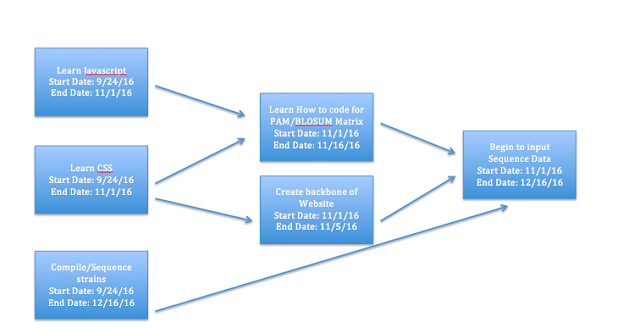
Updated Gantt Chart

Over the next three months I will be getting all the preliminary steps of creating a bioinformatics website out of the way. I will learn how to code in Javascript and CSS and then begin gathering the data that the website will organize. Finally, I will start the laying the foundations of the website.
Initial Project Planning:
Identify the Problem:
Lyme disease is constantly evolving and new strains are emerging. This makes it increasingly hard to treat because the strains are evolving to evade antibiotics. We need to sequence all existing strains and find which sections are increasing virulence and allowing the strains to evade the immune system and which sections are conserved.
Prior Art Survey:
There is a bioinformatics site which has compiled the sequences of 35 genomes of 8 LB species and 7 RF species. It is a manually curated site which includes comparisons of phylogeny, synteny and sequence alignments of orthologous sequences and intergenic spacers. (http://borreliabase.org/)
Literature Review:
Can be found in previous posts.
Solution Space Exploration:
Since a site already exists with with MSA, phylogeny and synteny. They do not have a complete genome for most strains. They also do not have the functions of each gene.
High Level Design:
I need to get in contact with the people who wrote the paper I read over the summer about lime disease before I start my project.
Tools:
If I plan to work off of the existing database for lyme disease I will need just a computer and possibly access to the NCBI database, in order to read the articles on lyme disease strains. I could access these through the library.
If I plan to work with sequencing that have not been sequenced yet, then I will need access to a lab or some sort of collaboration with a lab to sequence the rest of the genome.
I will need a mentor who knows about the lyme disease genome
Budget:
Most likely 0$
http://www.novusbio.com/diseases/lyme-disease
http://bmcbioinformatics.biomedcentral.com/articles/10.1186/1471-2105-15-233
Bioinformatics Slide:
https://docs.google.com/presentation/d/17VzdZdIEADFSacXulYF5ocCSfWaYhgboPMJYiH3iaGA/edit?usp=sharing

Updated Gantt Chart

Over the next three months I will be getting all the preliminary steps of creating a bioinformatics website out of the way. I will learn how to code in Javascript and CSS and then begin gathering the data that the website will organize. Finally, I will start the laying the foundations of the website.
Initial Project Planning:
Identify the Problem:
Lyme disease is constantly evolving and new strains are emerging. This makes it increasingly hard to treat because the strains are evolving to evade antibiotics. We need to sequence all existing strains and find which sections are increasing virulence and allowing the strains to evade the immune system and which sections are conserved.
Prior Art Survey:
There is a bioinformatics site which has compiled the sequences of 35 genomes of 8 LB species and 7 RF species. It is a manually curated site which includes comparisons of phylogeny, synteny and sequence alignments of orthologous sequences and intergenic spacers. (http://borreliabase.org/)
Literature Review:
Can be found in previous posts.
Solution Space Exploration:
Since a site already exists with with MSA, phylogeny and synteny. They do not have a complete genome for most strains. They also do not have the functions of each gene.
High Level Design:
I need to get in contact with the people who wrote the paper I read over the summer about lime disease before I start my project.
Tools:
If I plan to work off of the existing database for lyme disease I will need just a computer and possibly access to the NCBI database, in order to read the articles on lyme disease strains. I could access these through the library.
If I plan to work with sequencing that have not been sequenced yet, then I will need access to a lab or some sort of collaboration with a lab to sequence the rest of the genome.
I will need a mentor who knows about the lyme disease genome
Budget:
Most likely 0$
http://www.novusbio.com/diseases/lyme-disease
http://bmcbioinformatics.biomedcentral.com/articles/10.1186/1471-2105-15-233
Bioinformatics Slide:
https://docs.google.com/presentation/d/17VzdZdIEADFSacXulYF5ocCSfWaYhgboPMJYiH3iaGA/edit?usp=sharing
Thursday, September 15, 2016
Bioinformatics Week 9
Progress on project compiled:
https://docs.google.com/presentation/d/17VzdZdIEADFSacXulYF5ocCSfWaYhgboPMJYiH3iaGA/edit?usp=sharing
https://docs.google.com/presentation/d/17VzdZdIEADFSacXulYF5ocCSfWaYhgboPMJYiH3iaGA/edit?usp=sharing
Saturday, September 3, 2016
Bioinformatics Week 8
Next generation sequencing: Generates large amount of sequences.
The price of sequencing has dropped significantly since the start of sequencing.
454 Pyrosequecning
The price of sequencing has dropped significantly since the start of sequencing.
454 Pyrosequecning
- DNA is broken into smaller sequences.
- Attach single peice of DNA is attatched to a bead
- Single pieces of DNA on the beads are then applified
- Sequencing reactions occur and the sequencing data is created.
Illumina Sequencing
- DNA is broken into smaller sequences
- Clusters of the DNA are created by adding adapters(stick together non congrous DNA)
- Clusters are amplified in PCR
- Then you sequence each individual cluster by adding in primers and nucleotides which are tagged with different colored florescences.
The current sequencing technologies fall short in some aspects. First, they all break the DNA into smaller segments and then sequence them. So you are sequencing small parts and it's harder to see the bigger picture. You have to try to piece back together the small sequences to figure out what the whole piece of DNA was. When there are repetitive regions within DNA it becomes more complicated to piece back the DNA sequences once you have sequenced it. You don't know where these sequences were located on the DNA. Putting the sequences back together is called assembly. There are different programs which assemble the sequences (ABySS, SOAPdenovo, Velvet). When you are given an assembly you are also given an assembly score. This assembly score comes with the number of contigs (overlapping sequences). The fewer contigs the better.
RNA-seq: Sequences mRNA. Can identify if alternative splicing events have occurred (removing introns, not removing introns, etc)
- DNA is broken into smaller sequences
- Clusters of the DNA are created by adding adapters(stick together non congruous DNA)
- Sequence it
Metagenomics: Studying the sequences of microbial organism in their natural environments by just taking samples of their environment (soil, water, etc) and then you sequence it using next generation sequencing. Before you would have to remove the organism from its natural environment and then culture it in an artificial lab environment which could alter your results.
Friday, September 2, 2016
Bioinformatics Week 7
Selection analysis: Tries to identify whether natural selection is occurring or not as well as if the selection is to get rid of a certain sequence or promote a sequence. Then how this selection affects the species.
3 types of selection
3 types of selection
- Negative: Removes a detrimental mutation.
- Positive: Bennificial mutation promoted.
- Balancing/Diversfying seleciton: Favors the maintenance of multiple variations of a sequence in a diverse environment.
When measuring selection there are two standard techniques
- Tajima's D: Based on a few standard principles. The genetic regions near a region which is being selected for get dragged into the selection process (genetic hitchhiking). The length of the genetic region is dependent on the rate of recombination. Theta equals to Pi when no selection is occurring. When theta is greater than Pi then positive selection is occurring. When theta is less than Pi then balancing selection is occurring. Advantages: Good however can be fooled by other factors (ex:bottleneck mistaken for positive selection). Therefore after you preform Tajima's D you must preform other tests to single out chances of error in your data.
- dN/dS: This calculates the ratio of nonsynonmous mutations (change the protein) to synonemous mutations (doesn't affect protein). Very good for figuring out if there are specific sites which are being selected for and then figure out which codons are being selected for. No selection dN/dS=1, negative selection dN/dS<1, positive selection dN/dS>1.
There are two popular ways of quantifying selection (measuring variation)
- Theta: Based on the number of variable(changed between species) sites in a sample
- Pi: Based on the average number of differences between sequences. More sensitive to the frequency of a variation.
Subscribe to:
Posts (Atom)